
IMPORTANT: This article provides general information only. Visa requirements can change, and the appropriate option depends on each student’s individual circumstances. Students should check the latest information from the Department of Home Affairs and seek qualified advice where appropriate.
1. Check Your Student Visa Expiry Date
The first step is to confirm exactly when your current visa expires.
International students can use Visa Entitlement Verification Online (VEVO) to check their visa details and conditions. VEVO provides information such as your visa type, expiry date, period of stay and visa conditions.
Do not assume that your visa expires on the same date as your course. Your course completion date and visa expiry date may be different.
Before planning your next step, review:
- Your current visa subclass
- Visa expiry date
- Visa conditions
- Course completion date
- Current Confirmation of Enrolment (CoE)
- Overseas Student Health Cover (OSHC)
- Academic progress
- Future study and career plans
Having this information available can make the planning process much easier.
2. Start Planning Before Your Visa Expires
One of the most important things an onshore student can do is start planning early.
If your visa is approaching expiry, you may need to consider whether you are going to complete your studies, continue studying, explore a graduate pathway or investigate another visa option for which you may be eligible.
Starting early gives you time to research your options, compare courses and providers, prepare documents and understand any requirements that may apply.
Waiting until your visa has only a few weeks remaining can create unnecessary pressure, particularly if you need to make an important education or visa-related decision.
A good starting point is to review where you are now and where you want your Australian education journey to go next.
3. Are You Planning to Continue Studying?
Some onshore students decide to continue their education after completing their current qualification.
You may be considering:
- A higher-level qualification
- A specialised course
- A vocational or trade qualification
- A postgraduate course
- A course related to your career interests
- A different field of study
Further study should be chosen carefully. The course should make sense in relation to your previous education, skills and future goals.
For Student visa applications, the Genuine Student requirement applies to applications lodged from 23 March 2024. Applicants are required to demonstrate that they are genuine students and that studying in Australia is the primary reason for the Student visa application.
This means students should understand their proposed course and be able to explain how it fits their circumstances and future plans.
4. What If You Want to Change Your Course or Provider?
Not every student finishes their Australian study journey with the same plans they started with.
You may discover that your current course does not match your interests, or you may decide that another qualification is more relevant to your career goals.
If you are considering changing your course or education provider, it is important to understand the implications before making a decision.
Consider:
- Why you want to change your course
- How the new course relates to your previous studies
- Whether the new provider is suitable for international students
- Whether a new CoE is required
- How the change may affect your visa circumstances
- Whether the new course supports your genuine education and career objectives
Students should avoid withdrawing from their existing course simply because they have found another course they are interested in. It is better to understand the relevant requirements first.
What Happens After You Complete Your Course?
Completing an Australian qualification is an important milestone, but it is also the point when many students need to think carefully about what comes next.
Your next step could involve:
Further study → Graduate opportunities → Career development → Exploring eligible visa pathways
Some graduates may investigate whether they meet the requirements for a Temporary Graduate visa (subclass 485).
However, completing an Australian qualification does not automatically mean that a graduate is eligible for a particular visa.
Visa requirements can include specific criteria relating to the qualification, study requirements, age, English-language ability and other circumstances. These requirements can also change.
If you are considering a graduate pathway, research the current requirements well before your Student visa expires.
6. Could Skilled Migration Be Part of Your Long-Term Plan?
For some international students, career planning may eventually include exploring skilled migration options.
Depending on individual circumstances, students may investigate pathways such as:
- Skilled Independent visa (subclass 189)
- Skilled Nominated visa (subclass 190)
- Skilled Work Regional (Provisional) visa (subclass 491)
- Employer-sponsored pathways, where eligible
However, students should understand that completing a particular course does not guarantee permanent residency.
Eligibility for skilled pathways can depend on factors such as occupation, skills assessment, English-language requirements, points, nomination criteria, work experience and other applicable requirements.
If migration is part of your long-term plan, it can be useful to consider your intended occupation and career direction when selecting further study.
7. Keep Your Important Documents Organised
Planning your next step is easier when your important documents are readily available.
Depending on your circumstances, these may include:
- Passport
- Visa grant information
- VEVO details
- Current CoE
- Academic transcripts
- Course completion documents
- English test results, where applicable
- OSHC information
- Employment documents, where relevant
- Previous Australian study records
Check whether any documents need to be updated before you begin your next application or enrolment process.
Students should also keep copies of their previous qualifications and academic records, as these may be useful when discussing future study options.
8. Check Your Visa Conditions
Your visa conditions are another important part of planning.
Students should understand the conditions attached to their current visa and make sure they continue to comply with them.
You can check your current conditions through VEVO or your visa grant information.
It is particularly important to understand whether any conditions affect your ability to apply for another visa while you are in Australia.
For example, certain visas can include a No Further Stay condition. If such a condition applies, specific requirements may need to be considered before applying for another substantive visa onshore.
Do not assume that every Student visa holder has the same conditions. Check your own visa details.
9. What If Your Visa Is Very Close to Expiring?
If your Student visa is approaching its expiry date and you want to remain in Australia, you should understand what lawful options may be available to you before the current visa expires.
The Department of Home Affairs states that you must have a valid visa to remain in Australia. Whether you can apply for another visa while in Australia depends on your individual circumstances and the conditions attached to your current visa.
If you remain in Australia without a valid visa, you may become unlawful and could face serious immigration consequences.
For this reason, do not wait until your visa has expired before seeking information about your situation.
Early planning is always preferable to making an important decision under time pressure.
10. Think About Your Long-Term Goals
Your next course or visa decision should ideally form part of a broader plan.
Ask yourself:
If yes, what qualification genuinely supports your education and career goals?
If yes, what skills, experience or professional requirements does my intended occupation involve?
If yes, what are the current requirements for the relevant occupation and pathway?
If your situation involves complex visa matters, consider obtaining advice from an appropriately qualified professional.
Thinking about these questions before your visa expires can help you approach your next step with greater clarity.
Final Thoughts
Having an Australian Student visa that is nearing expiry is an important reminder to start planning your next step.
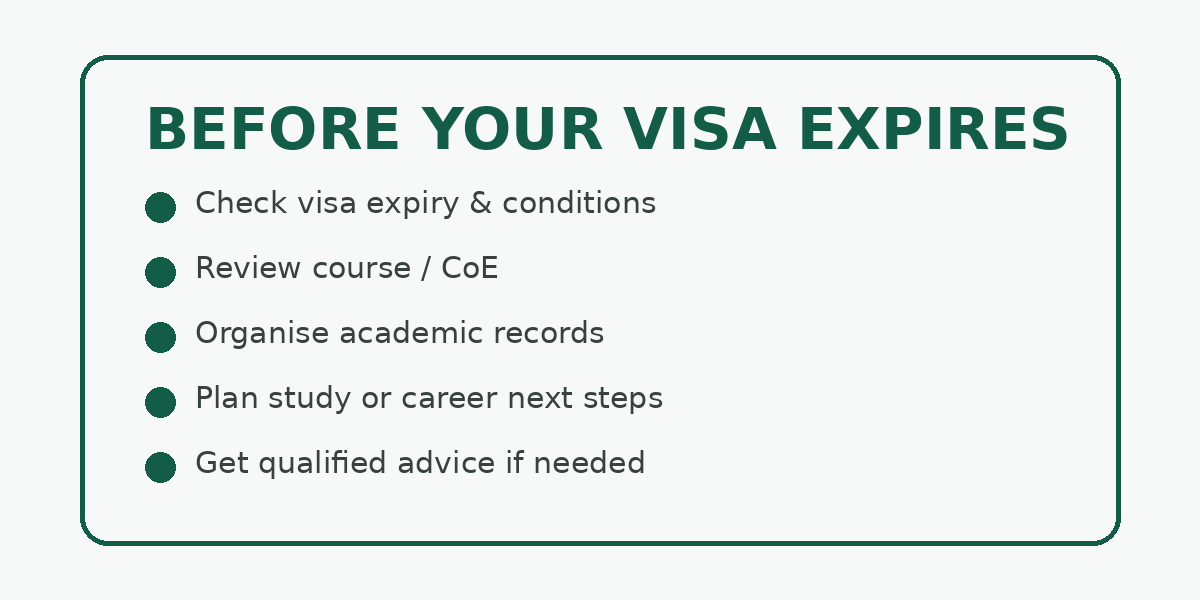
Begin by checking your visa expiry date and conditions, reviewing your course completion date and considering your education and career goals.
For some students, further study may be the appropriate direction. Others may explore graduate opportunities, employment or eligible future visa pathways.
There is no single pathway that applies to every student. Your previous education, current course, visa conditions, career goals and individual circumstances all need to be considered.
Most importantly, do not leave your planning until the last minute. Understanding your options early can give you more time to make an informed decision and take the appropriate steps before your current visa expires.