
For international students planning to study in Australia, choosing the right city is about more than finding a university.
The location of your studies can influence your living experience, access to employment, career opportunities and, for eligible students, potential post-study and skilled migration pathways.
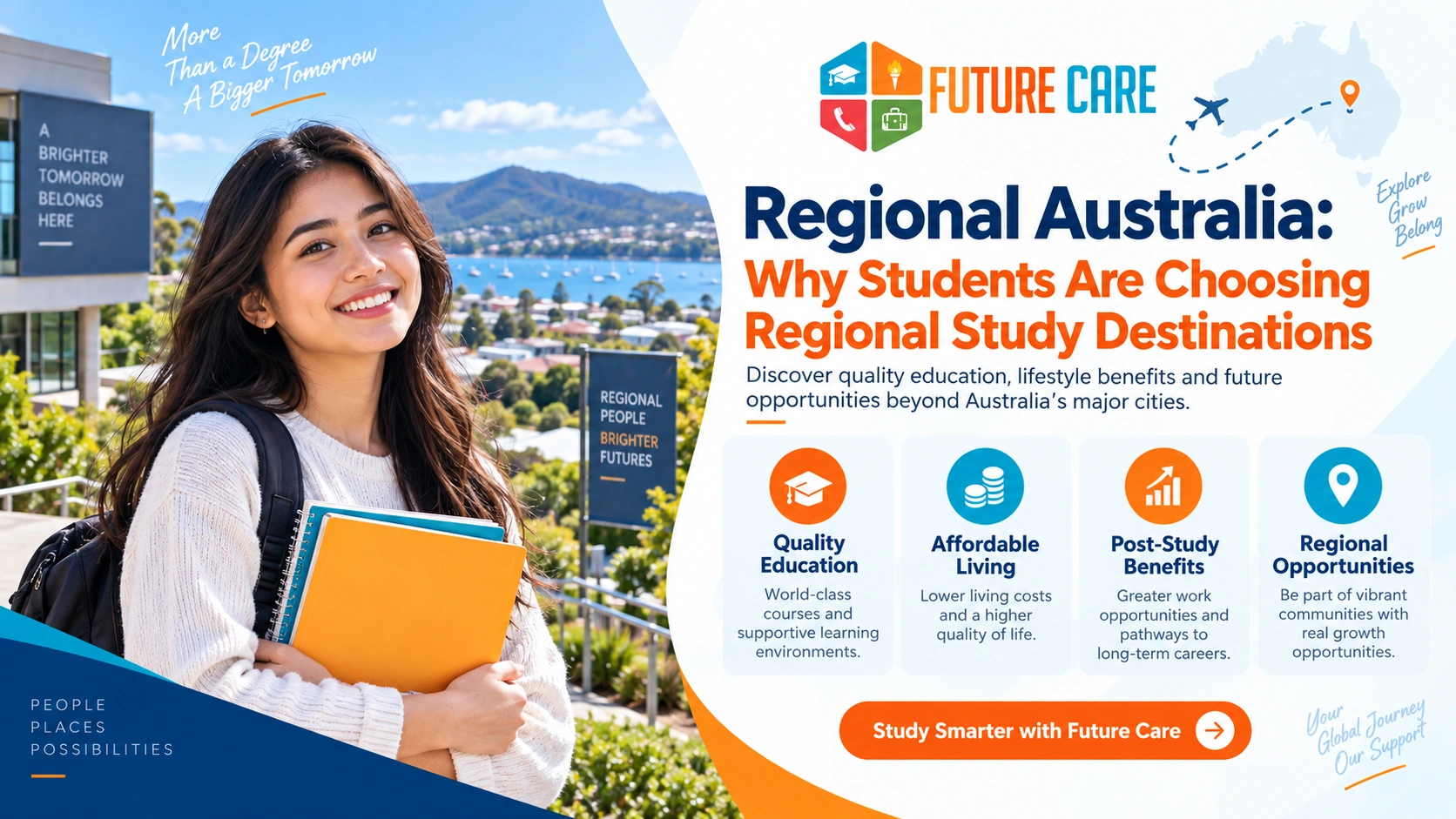
This is one reason regional Australia is becoming an increasingly important option for international students.
Studying in a designated regional area can provide access to quality education while also opening up regional opportunities that may not be available to students who remain entirely in Australia’s major metropolitan areas.
From the possibility of additional post-study work rights to regional skilled migration pathways such as the Skilled Work Regional visa (subclass 491) and the Permanent Residence (Skilled Regional) visa (subclass 191), regional study can form an important part of a student’s long-term Australian education and career strategy.
However, regional study is not a guaranteed pathway to permanent residency. The benefits depend on the student’s course, location, occupation, points, visa history and ability to meet the relevant requirements.
What Is Regional Australia?
When people hear the term “regional Australia”, they sometimes imagine only small rural towns.
That is not necessarily the case.
Australia’s designated regional areas include a range of locations, from smaller regional communities to major regional centres and cities. The classification used for migration purposes is defined by the Australian Government and can differ depending on the relevant visa or program.
This means students can study in locations that provide universities, public transport, healthcare, shopping, employment opportunities and a strong student community while still being considered regional for relevant migration purposes.
Students should always check the current designated regional area classification for their specific campus and postcode before making a decision.
Why Are International Students Choosing Regional Australia?
- More Options Beyond Australia’s Biggest Cities
Sydney, Melbourne and Brisbane have traditionally been the most popular destinations for international students.
However, studying outside these major metropolitan areas can provide students with more options when comparing universities, courses, accommodation and career opportunities.
Regional destinations can offer:
- Universities and higher education providers
- TAFE and vocational education
- Industry-linked courses
- Healthcare and community services
- Engineering and technology opportunities
- Agriculture and environmental industries
- Tourism and hospitality
- Professional employment opportunities
The important point is that regional study does not necessarily mean sacrificing access to quality education.
- Potentially More Manageable Living Costs
The cost of living is an important consideration for international students.
Depending on the location, some regional cities can offer lower accommodation and everyday expenses compared with Australia’s largest metropolitan areas.
This can make regional study attractive to students who want to manage their overall education budget more carefully.
However, students should not assume that every regional area is automatically cheaper.
Rent, transport, groceries and other expenses can vary considerably between locations. A proper comparison should be made before choosing a university.
- Regional Study Can Be Part of a Longer-Term Migration Strategy
For some students, the biggest attraction of regional Australia is not simply the lifestyle.
It is the possibility of creating a longer-term pathway from study to post-study work and, where eligible, skilled migration.
A student might follow a pathway such as:
Study in a designated regional area → Temporary Graduate visa → regional employment → skilled regional pathway → Permanent Residence (subclass 191), if eligible
This is not an automatic pathway and each stage has its own requirements.
But for students who are already considering skilled migration, choosing a regional location at the beginning of their Australian study journey can be strategically important.
- Regional Study and the Second Temporary Graduate Visa
One of the major advantages that can make regional study attractive is the possibility of a Second Temporary Graduate visa (subclass 485) in the Post-Higher Education Work stream.
Eligible graduates may receive an additional 1 or 2 years of post-study work rights depending on their study location and subsequent regional residence.
Under the current rules, applicants generally need to:
- Hold an eligible first Temporary Graduate visa
- Have completed an eligible degree with an Australian education provider in a designated regional area
- Have lived in an eligible designated regional area for at least two years immediately before applying
- Meet the relevant age, health, character and other visa requirements
The additional period depends on the regional category and the applicant’s study and residence history.
For example, eligible students who studied and lived in certain Category 2 regional locations may receive 1 additional year, while eligible students who studied and lived in Category 3 regional locations may receive 2 additional years. Tasmania has some specific exceptions.
- Regional Study Can Also Support Skilled Migration Points
Regional study can also be relevant when calculating points for Australia’s points-tested skilled migration visas.
The Skilled Work Regional (Provisional) visa (subclass 491) is one of the key regional skilled pathways.
The 491 is points-tested and requires an Expression of Interest through SkillSelect. Applicants need to meet the relevant eligibility requirements, including an eligible occupation, skills assessment, English and points requirements, as well as the requirements for state/territory nomination or eligible family sponsorship.
Importantly, state or territory nomination for the subclass 491 currently provides 15 additional points.
Therefore, students planning their education with a future skilled migration strategy may find regional study particularly relevant when assessing their potential points score.
Regional study itself can also contribute points where the applicant satisfies the separate regional study requirement.
The exact points available depend on the applicant’s individual circumstances, so students should calculate their complete points profile rather than assuming that regional study alone guarantees an invitation.
- How Does the 491 Visa Lead to the 191 Visa?
One of the most important reasons skilled migrants consider the subclass 491 is its connection to the Permanent Residence (Skilled Regional) visa (subclass 191).
The basic pathway can be understood as:
Step 1: Obtain a 491 Visa
The Skilled Work Regional (Provisional) visa (subclass 491) allows eligible skilled migrants to live and work in designated regional Australia.
A 491 applicant generally needs to:
- Be invited to apply
- Submit an Expression of Interest
- Have an eligible occupation
- Obtain the required skills assessment
- Meet the relevant English requirement
- Meet the points test
- Receive state/territory nomination or eligible family sponsorship
- Meet health and character requirements
The 491 is a provisional visa, not permanent residency.
Step 2: Live and Work in Regional Australia
After receiving the 491, the visa holder must comply with the conditions attached to the visa, including the regional requirements.
This is an important part of the pathway.
The 491 should not be viewed simply as a way to obtain a visa and then immediately move to Sydney or Melbourne.
The purpose of the regional visa program is to encourage skilled migrants to live and work in regional Australia.
Step 3: Complete the Regional Requirement
The subclass 191 provides a permanent residence pathway for eligible holders of regional provisional visas.
The Department of Home Affairs states that holders of regional provisional visas need to demonstrate that they have lived and worked in regional Australia while holding the relevant visa.
The current legislative framework requires the applicant to satisfy the relevant regional provisional visa conditions and provide the required Australian Taxation Office Notices of Assessment for three relevant income years.
This is why students and skilled migrants should keep careful records of:
- Residential addresses
- Rental agreements
- Utility bills
- Employment records
- Payslips
- Tax returns
- ATO Notices of Assessment
- Other evidence supporting their regional residence and work history
Step 4: Apply for Subclass 191 Permanent Residence
Once the applicant meets the relevant requirements, they can apply for the Permanent Residence (Skilled Regional) visa (subclass 191).
The 191 is a permanent visa.
This is a major difference between the two visas:
491 = provisional regional visa
191 = permanent residence
The 191 pathway is available to eligible holders of regional provisional visas, including subclass 491 and subclass 494 holders.
Why Can This Be Valuable?
An additional year or two can provide a graduate with more time to:
- Gain Australian work experience
- Develop professional skills
- Build industry connections
- Improve their career position
- Explore eligible skilled migration options
- Meet requirements for another visa pathway
This additional time can be particularly valuable for graduates who need more time to establish themselves professionally after completing their studies.
What Are the Main Advantages of the 491 → 191 Pathway?
For an eligible applicant, the regional pathway can offer several advantages.
- A Structured Pathway to Permanent Residence
The 491 provides a structured route toward the 191 permanent visa once the applicant meets the required regional and other criteria.
- Additional Points
A subclass 491 nomination provides 15 additional points under the points-tested skilled migration system.
This can make a significant difference to an applicant’s overall points score.
- Regional Employment Opportunities
Regional areas can have workforce shortages across sectors such as healthcare, education, construction, engineering, agriculture, hospitality and other industries.
The Department of Home Affairs also notes that regional skilled migration provides access to a broader range of occupations in some regional visa programs.
- Potentially Less Competition Than Major Metropolitan Pathways
State and territory nomination programs are designed around the workforce and demographic needs of individual jurisdictions.
However, nomination places are limited and requirements vary between states and territories.
Therefore, regional migration should be viewed as an opportunity rather than a guaranteed or easier pathway.
- Permanent Residence Can Provide Greater Flexibility
Once a person obtains Australian permanent residence through the subclass 191, they are no longer on a provisional regional visa.
This can provide significantly greater flexibility for their long-term life and career in Australia.
What Happens After Getting Permanent Residence?
The regional commitment is particularly important while the applicant is pursuing the 491-to-191 pathway.
Once the subclass 191 permanent visa is granted, the person becomes an Australian permanent resident.
This can provide access to a much broader range of opportunities, including greater flexibility regarding where they live and work in Australia, subject to the normal conditions of permanent residence.
The important distinction is:
Regional obligation → 491 period
Permanent residence → 191 grant
Students should therefore understand that moving to a regional area is not simply about staying regional forever. For eligible applicants, it can be part of a structured long-term migration strategy.
Why Should a Student Consider Moving from a Non-Regional Area to a Regional Area?
Some students initially choose Sydney, Melbourne or Brisbane because these cities are well known among international students.
Later, after completing their studies, they may start considering regional Australia because they want to explore additional post-study and skilled migration opportunities.
Moving from a non-regional location to an eligible regional area can potentially provide access to benefits that a student who remains in a major metropolitan area may not have.
These may include:
Additional Temporary Graduate Visa Opportunities
Eligible graduates who meet the regional study and residence requirements may be able to obtain a second Temporary Graduate visa with an additional 1 or 2 years, depending on the applicable regional category and circumstances.
Regional Skilled Migration
Regional Australia provides access to skilled pathways such as subclass 491 and employer-sponsored regional pathways such as subclass 494.
Additional Points
A 491 nomination currently provides 15 additional points, which can significantly increase an applicant’s total points score.
More Time to Build a Career
An additional period in Australia can give graduates more time to gain relevant experience, develop professional networks and assess suitable skilled migration options.
Regional Study Is Not Just About Migration
Although migration can be an important consideration, students should not choose a regional university only because they have heard that it leads to PR.
A good study decision should also consider:
- The quality of the course
- Accreditation
- University reputation
- Course content
- Career outcomes
- Internship or placement opportunities
- Tuition fees
- Accommodation
- Transport
- Lifestyle
- Local employment opportunities
- The student’s academic and professional goals
A regional location should make sense for the student’s education and career, not only their visa strategy.
Who Should Consider Regional Australia?
Regional Australia may be particularly worth considering for students who:
- Want to explore alternatives to Sydney, Melbourne and Brisbane
- Are concerned about living costs
- Prefer a quieter lifestyle
- Want stronger connections with smaller communities
- Are interested in regional employment opportunities
- Want to explore post-study work options
- Are considering skilled migration in the future
- Want to maximise their available migration options where eligible
The best regional destination will depend on the student’s individual circumstances.
A Simple Regional Study-to-Migration Pathway
For students considering both education and their future career in Australia, the journey may look like this:
Step 1 — Choose a suitable course
↓
Step 2 — Study with an eligible education provider in a designated regional area
↓
Step 3 — Graduate and apply for an eligible Temporary Graduate visa
↓
Step 4 — Continue living in the designated regional area
↓
Step 5 — Use the additional regional post-study period where eligible
↓
Step 6 — Build Australian work experience and assess skilled migration options
↓
Step 7 — If eligible, pursue a regional skilled pathway such as subclass 491
↓
Step 8 — Meet the relevant regional and other requirements
↓
Step 9 — Apply for subclass 191 Permanent Residence when eligible
This pathway is not automatic, and requirements can change. However, understanding the potential pathway early can help students make better decisions about where they study and what they study.
How Future Care Can Help
Choosing a university is only one part of planning your Australian education journey.
At Future Care Education & Migration, we help students look at their options from both an education and future career perspective.
Our team can assist students with:
- Course selection
- University selection
- Regional study options
- Admission applications
- Scholarship opportunities
- Student visa guidance
- Post-study planning
- Skilled migration pathway assessment
- Regional study and career planning
If you are considering studying in Australia, don’t choose your destination based only on the university’s name or the city’s popularity.
The right location can be an important part of your long-term study and career strategy.
Talk to Future Care Education & Migration to explore whether a regional study option could be suitable for your academic background, career goals and future plans.
Frequently Asked Questions (FAQs)
Yes. Regional Australia offers a range of universities, education providers, employment opportunities, lifestyle benefits and, for eligible students, regional migration pathways.
No. Studying in a regional area does not guarantee permanent residency. Skilled migration pathways have separate eligibility, points, occupation, nomination, skills assessment and other requirements.
The subclass 491 is a provisional regional visa that can provide a pathway to the subclass 191 permanent visa for eligible applicants who meet the relevant requirements.
The subclass 191 regional provisional pathway requires the applicant to satisfy the relevant three-year requirements and provide the required evidence for three relevant income years. Applicants must also comply with their regional provisional visa conditions.
A subclass 491 nomination or eligible family sponsorship provides 15 additional points under the points-tested skilled migration system.
Eligible graduates may qualify for a Second Temporary Graduate visa in the Post-Higher Education Work stream. Depending on the relevant study and residence locations, the additional stay can be 1 or 2 years. Applicants must meet the specific eligibility requirements, including the regional residence requirement.
Potentially, yes, but simply moving does not automatically create eligibility for every regional benefit. Different programs have different study, residence and visa requirements. For example, the Second Temporary Graduate visa has specific requirements concerning where the applicant studied and where they lived before applying.
No. Regional study can be beneficial even for students who do not plan to migrate permanently. Students may choose regional locations because of the course, lifestyle, community, costs or career opportunities.
Final Thoughts
Regional Australia is becoming an increasingly important consideration for international students who want to look beyond the traditional metropolitan study destinations.
For the right student, regional study can combine quality education, lifestyle benefits, potential additional post-study work rights and access to regional skilled migration pathways.
The key is to plan early.
Rather than asking only, “Which university should I choose?”, students should also consider:
“Which course, location and career pathway best support my long-term goals?”
For some students, the answer may be regional Australia.
Future Care Education & Migration — helping students make informed decisions about study, career and their future in Australia.
Disclaimer: Australian immigration laws, visa settings, regional classifications and eligibility requirements can change. The information in this article is general information only and does not constitute individual migration advice. Students should check the latest information from the Australian Department of Home Affairs or obtain advice from an appropriately authorised migration professional before making decisions.